
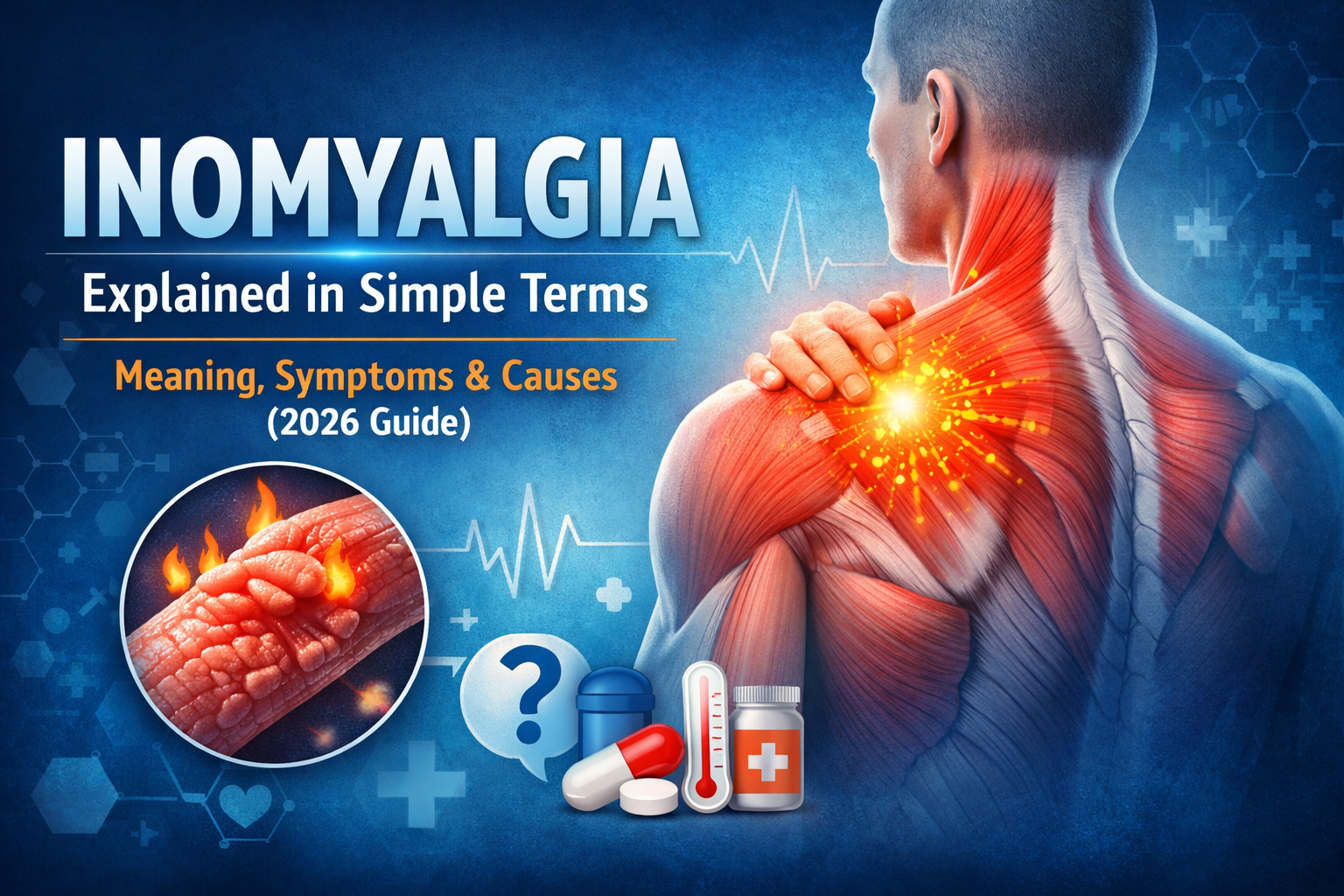
When you have just encountered the word inomyalgia and are only guessing in the meaning of the term, you are not the only one. The term is already being pushed into online search engine results, forums and health-related debates but there is still a dearth of certain information on it.
Within the framework of this exhaustive guide of 2026 we will define inomyalgia in simple terms, discuss its potential meaning, symptoms and causes and we will also explain whether it is a legitimate medical condition. All is written in an easily comprehensible style thus not requiring a medical background to understand.
What Is Inomyalgia? (Simple Definition)
Let’s break the word down.
The term appears to combine:
● “Ino-” (possibly fiber or tissue in a medical context)
● Myalgia, which is the pain of muscles.
The original name of the word myalgia is of Greek origin:
● “Myo” = muscle
● “Algia” = pain
In simple terms therefore, inomyalgia appears to mean muscle pain which could be related to tissue or inflammatory involvement.
But this is the significant point:
Inomyalgia is not an official medical diagnosis in major medical classification systems in the present time.
It may be:
● A newly emerging term
● A typo or difference of another disorder.
● An informal word which is incorporated informally in the web.
Due to this fact, it is highly important to comprehend what context the word is used.
Is Inomyalgia a known Medical Psyche?
By 2026, inomyalgia has not been formally recognized as a condition in major diagnostic manuals.
As an example, well-known muscle-related disorders are:
● Fibromyalgia- A long-term illness that is typified by the presence of musculoskeletal pain, fatigue, and tenderness throughout.
● Myositis– Muscle inflammation.
● Polymyalgia rheumatica- an auto inflammatory syndrome that inflicts pain and stiffness in the muscles particularly in the elderly.
As the inomyalgia does not manifest itself in the presence of the following known diagnoses, it can be:
● A report of inflammation in muscle.
● Mixing of myalgia with inflammatory disorders of muscle.
● New or popular health-related keyword.
When hearing the word in a report or on an online discussion, you should always seek the help of a healthcare specialist to give you a clear understanding.
What Causes Inomyalgia? (Possible Explanations)
Due to the fact that the term is not officially outlined, we can discuss potential causes of the term in relation to muscle pain and inflammatory diseases.
The following are some of the typical causes of muscle related pain that individuals may relate with inomyalgia:
1. Muscle Overuse or Strain
● Intense exercise
● Heavy lifting
● Poor posture
● Repetitive movements
This is a form of pain, which is most likely to go away with rest.
2. Myocardial inflammation.
Inflammation can cause:
● Swelling
● Tenderness
● Warmth in the affected area
● Stiffness
The causes of inflammatory muscle pains would include:
● Autoimmune reactions
● Infections
● Injury
3. Muscle Pain Viral or Post-Infection.
Most viral diseases result in muscle pains. For example:
● Flu
● Viral infections
● Fatigue conditions after the virus.
In some cases, there is persistent muscle pain following the recovery.
4. Stress and Tension
Emotional stress can lead to:
● Muscle tightness
● Neck and shoulder pain
● General body aches
Persistent stress can be a cause of constant muscle pains.
5. Chronic Pain Conditions
Other chronic pain disorders like Fibromyalgia are where the pain in the muscles is widespread and there is no inflammation that is visible.
In case an individual is applying the term inomyalgia to refer to persistent and unexplained muscle pain, it would be overlapping with those general conditions.
General symptoms related to Inomyalgia.
Even though there is no specific list of the symptoms, the conditions related to muscle pains typically include:
● Dull or aching muscle pain
● Tenderness when touched
● Muscle stiffness
● Fatigue
● Reduced range of motion
● The slight swelling (in case of an inflammation)
In more extreme situations, the symptoms may include:
● Weakness
● Constant pain during several weeks.
● Pain which disrupts the day time activities.
When the muscle pain does not go away within a few days, then it is prudent to seek medical attention.
The Difference between Inomyalgia and Myalgia.
Myalgia is a legitimate medical terminology and as such, it is prudent to have a clear understanding of the term.
What Is Myalgia?
Myalgia merely refers to pain in muscles. It can be:
● Localized (one area)
● Generalized (whole body)
● Mild or severe
● Short-term or chronic
Is Inomyalgia Different?
No medical distinction has been made. But there are other readings, which indicate:
● Myalgia = general muscle pain
● Inomyalgia = pain in the muscles which may be associated with inflammation or tissue interference.
Until the term is officially defined in the medical literature, it is always safe to consider it as the variation or informal manifestation of muscle discomfort.
How Is Muscle Pain Diagnosed?
In the event that you consult a medical practitioner because of ongoing muscle discomfort,
he/she may:
● Review your medical history
● Perform a physical exam
● Order blood tests (to check the inflammation indicators)
● Recommend imaging (tinker imaging in the case of suspicion of injury).
Physicians are interested in eliminating such conditions as:
● Myositis
● Polymyalgia rheumatica
● Autoimmune disorders
Before making any label it is important to be properly diagnosed.
Muscle pains: How to treat them (Including possible inomyalgia).
In case of muscle pain, the following are practical measures, which may be taken:
1. Rest and Recovery
Give your muscles a rest after strain or overuse.
2. Gentle Stretching
Stretching of light enhances circulation and flexibility.
3. Heat or Cold Therapy
● Ice reduces inflammation
● Heat relaxes tight muscles
4. Hydration
The loss of water may aggravate muscle spasms and pain.
5. Anti-Inflammatory Measures
Some people use:
● Pain relievers that are sold over the counter.
● Anti-inflammatory diets
● Omega-3 rich foods
One should never take a drug without consulting a medical professional.
When Should You See a Doctor?
Medical Consultation Children should consult physicians when they feel:
● Muscle pain is severe with no injury.
● Lasting pain of over two weeks.
● Muscle weakness
● Fever with muscle pain
● Swelling and redness
Such symptoms can be a sign of a more dangerous underlying disease.
What Is the Reason the term Inomyalgia is being searched online?
The reasons could be a few:
1. Entering variation or typing error of myalgia.
2. New health terminology.
3. Discussion in the social media or forums.
4. Inflammatory muscle disorders have been confused.
People search to obtain clarity when new health-related words start trending. It is probably the reason why the interest in this term is increasing.
Frequently Asked Questions (FAQs).
Is inomyalgia a real disease?
Today, it is not considered an official diagnosis in the sphere of medicine. It seems to be a colloquial or a new word connected to muscle pains.
Can inomyalgia be serious?
In case it is associated with muscle pain that is related to inflammation or autoimmune diseases, it may be subject to medical treatment. Strain is mild pain that is not serious in the muscles.
The duration of muscle pain?
● Mild strain: 2–5 days
● Moderate strain: 1–2 weeks
● Chronic conditions: May take a long time of many months.
Does it mean that inomyalgia is like fibromyalgia?
Not officially. Nevertheless, when a person refers to the term to explain widespread pain in the muscle, it can be confused with such diseases as Fibromyalgia.
Final Thoughts
Simply put, inomyalgia can be defined as muscle pain that can be accompanied by inflammation or tissue discomfort, but that is not considered a medical diagnosis at the moment.
If you encounter this term:
● Don’t panic
● Consider the context
● Be symptom centered instead of label centred.
● Permanent pain should be checked with the physician.
Since terminology in the health care profession is dynamic, there are cases whereby new words are used even before they are formally defined. Up till that, the most important is to learn about muscle pain, its causes and the time when it is necessary to get assistance.
Quick Summary
● Inomyalgia is probably muscle pain which can be inflamed.
● It is not medically accepted in the medical classification systems.
● The symptoms are similar to the general myalgia.
● Strain, inflammation, stress, or infection may be the causes.
● Severe or chronic pain needs to be assessed by the doctor.