


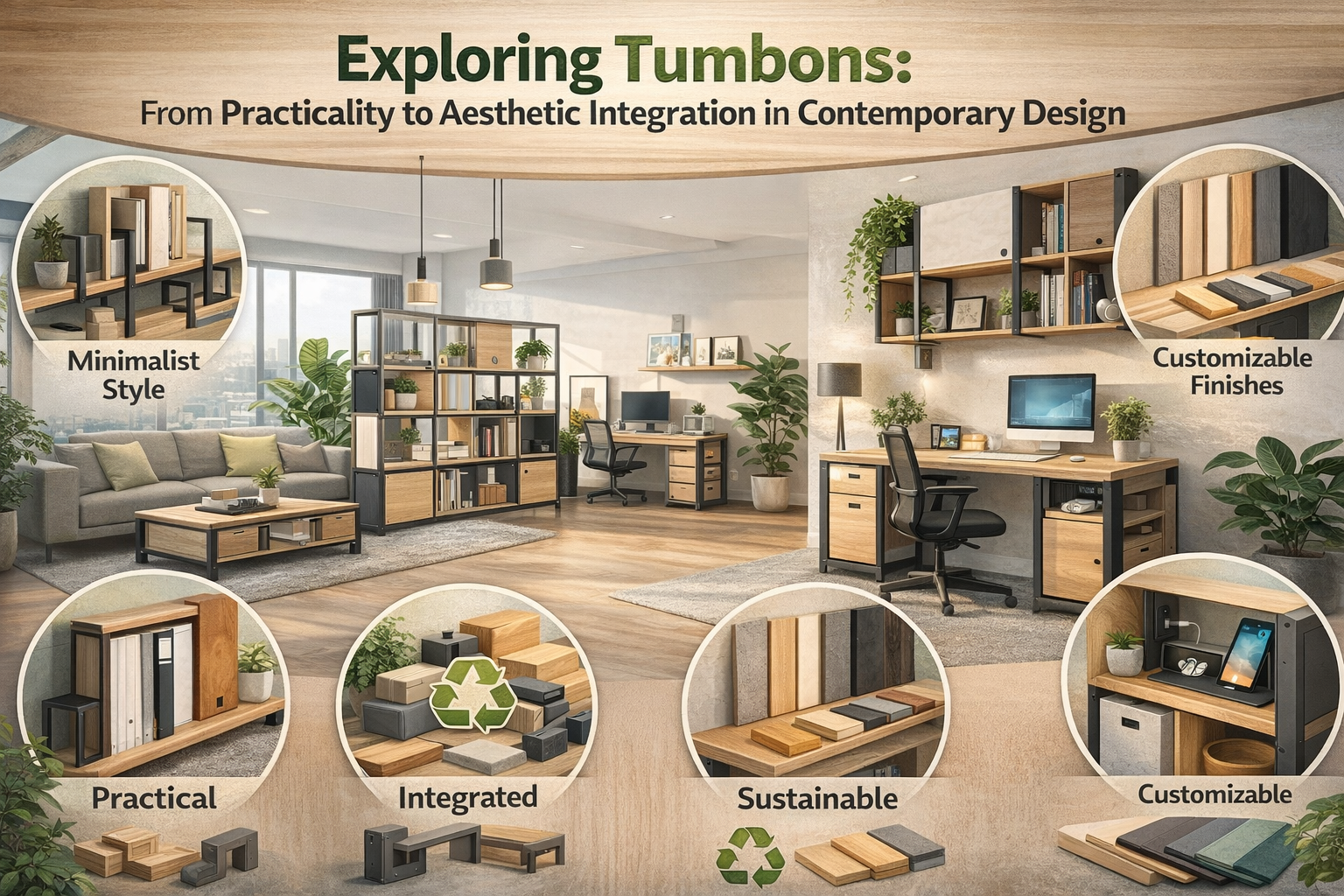
In the changing times of modern design, new ideas tend to come up that break the traditional borders of functionalism and beauty in design. Tumbons is one of such concepts that is gaining attention. Having been considered as only practical components, tumbans nowadays get the location of functionality and style. Designers, architects and creatives are increasingly incorporating tumbans in the present day spaces not merely in what they are doing, but in the way they appear and feel.
In this article, the authors discuss the development of tumbans as rather utilitarian elements into powerful design elements, which may be used to determine modern interior, product, and architectural ideas.
Profiling Tumbans: A Workable Basis.
In essence, tumbans are the features of structure, which have a functional role. In a design environment, they can be used as modular units, support systems, flexible components or integrated structural features depending on the situation.
The tumbans traditionally were appreciated because of:
● Durability
● Structural reliability
● Space efficiency
● Modular adaptability
Their original claim was their usefulness. They were used by designers to address issues; they could be space optimization, better organization, or mechanical system support. Nevertheless, with the development of the design philosophy, the concept of tumbans changed.
The Transfer to Design-Oriented Thinking.
Modern design does not just work. The modern-day consumers and professionals demand objects and spaces to provide both performance and aesthetics. This change has led the way to the re-invention of tumbans.
Modern design glorifies structural components as opposed to concealing them.
Tumbons are now:
● Bring out in the open instead of being hidden.
● Decorated to fit in interior motifs.
● Produced in different finishes and textures.
● Part of minimalist and industrial style.
Such a change is indicative of a larger trend: the functional is being transformed into a work of art.
Routine Uses of Tumbans in Present-day Areas.
1. Interior Architecture
Tumbans are commonly incorporated in modern day interiors in the following:
● Modular wall systems
● Storage frameworks
● Multi-functional furniture
● Partition structures
They can be used in open-concept residential and small-city settings due to their versatility. The tumbons give designers flexibility– a way to enable a space to be changed based on the requirements of the user.
An example of this is a living area which may include tumbon-based shelving which serves as a room divider and at the same time as a means of the structuring and expression of decoration.
2. Furniture and Product Design.
tumbles Furniture designers like tumbons because of their ability to be in a modular form.
In seating or table arrangements or shelving units, tumbons permit products to:
● Reconfigured easily
● Expanded or reduced
● Individualized to suit individual tastes.
This is in line with the increased individualization of design in modern times. The current demand of consumers is to have a versatile product, which expands with their way of life.
3. Business and Office Design.
Flexibility and teamwork are the main concerns of modern workplaces.
Tumbans are often included into:
● Adjustable desk systems
● Modular office partitions
● Smart storage units
● Exhibition installations
They are practical to provide structural integrity and their beauty refines the brand identity and work place attractiveness.
Aesthetic Integration: Form and Function Interaction.
The most interesting development is aesthetical development of tumbans.
Designers now consider:
● Color coordination
● Material contrasts
● Surface finishes
● Symmetry and repetition
Tumbans do not merely act as supportive structures anymore, they also help to render texture and rhythm.
Material Innovation
The modern tumbans can be made out of:
● Brushed metal
● Wood composites that are sustainable.
● Matte-finished polymers
● Reused industrial resources.
These material selections have a sustainability and style impact. As an illustration, matte black tumbans can complement an industrial loft, and the wood finishes of light colors should be used to complement Scandinavian minimalism.
Necessity of Minimalism in Tumbon Design.
Minimalism has played a major role in the perception and consumption of tumbans. Tumbans are viewed as neutral, clean, and uncluttered, which makes them fit in spaces perfectly.
Well-designed tumbens instead of overcrowding the environment:
● Enhance spatial clarity
● Provide structural balance
● Promote conscious simplicity.
They are geometric, which is ideally suitable to modern minimal design schools of thought.
Sustainability and Environmentally-Friendly Design.
The other factor that has been making tumbans popular is that they are compatible with sustainable design.
New designers are concerned with:
● Recyclable materials
● Long product lifecycles
● Modular repairability
● Reduced waste production
Since tumbans are usually modular, some parts can be substituted as opposed to politics of whole systems. This would help to decrease the environmental footprint and comply with the principles of circular design.
Moreover, more sustainable materials (recycled wood or recycled metals) are being utilized in the production of tumbon.
The Psychological Effect of Organised Design.
Design has an impact on our perception in a space. A sense of can be produced by structured and balanced systems such as tumbans.
● Stability
● Order
● Calmness
● Efficiency
Tumbons can be used to create rhythm and structure in the modern world where users can be overwhelmed with visual clutter. Their regular geometry is reassuring to the eye and understandable.
This is the psychological factor that leads to their increased assimilation both in residential and commercial environments.
Technology and Intelligent Integration.
With an increased technological integration of design, tumbans are being modified to fulfill smart environments.
On sophisticated applications, tumbans can have:
● Hidden wiring systems
● LED lighting integration
● Cable management channels
● Smart modular connectors
These attributes enable the designers to keep clean aesthetics, and keep up with modern technology demands.
An illustration is a tumbon-desk system which may have charging ports and wires installed under its body thus appearing smooth and clean.
Individualization and Individual Expression.
Customization is one of the most desirable features of tumbons in modern style. Users can:
● Select finishes
● Adjust dimensions
● Combine modules
● Modify configurations
Such malleability however turns tumbans into dynamic systems instead of rigid design components. Creativity and personal expression is promoted by the capacity to change layouts.
With individuality being a concern in the world, this kind of adaptability renders tumbans particularly pertinent.
Tumbons in Urban Living
Smart design solutions to problems in urban spaces are needed. Space is limited and multifunctional systems are needed and tumbons are the solution.
They can be used as in small apartments as:
● Convertible shelving units
● Compact storage frames
● Expandable workstations
● Furniture composite frameworks.
Their construction efficiency in form of modularity makes them suitable to the contemporary urban lifestyle where every square meter matters.
Future Trends Tumbon Design.
In the future, it is expected that tumbans develop in a number of major ways:
1. Increased Sustainability
Less harmful materials and less harmful production processes.
2. State of the Art Technology.
Smooth interconnecting systems that are easily assembled and disassembled.
3. Improved Diversity in Aesthetics.
More finishes, textures as well as color palettes.
4. Smart Integration
Uninterrupted integration of online functions and automation systems.
With modern design still focusing on flexibility and greenness, tumbans can be used in the future with ease.
Striking a Balance between Practicality and Beauty.
It is the balance of tumbans that makes them strong. They are a design ideology that does not compromise utility and aesthetics.
Good contemporary design poses:
● Is this aspect able to work effectively?
● Is it an improvement to the general look?
● Does it fit in future requirements?
Tumbans respond to all three in the affirmative.
They show that utilitarian elements can be raised to be aesthetic without losing their original use.
The reason designers are taking up Tumbons.
Professionals in the design world value tumbins due to the fact that they:
● Solve spatial challenges
● Support modular thinking
● Respond to sustainability objectives.
● Enhance visual structure
● Offer creative flexibility
They are versatile and can be used in a variety of styles, such as industrial and minimalist and in modern rustic and high-tech settings.
Conclusion
A visit to tumbans shows that there is a significant design philosophy change in the present day. What was initially intended to serve a genuine functional purpose has become a fine piece of design that helps with functionality as well as beauty balance.
In modular furniture to building structures, tumbans are the cars that show smooth merging of the architectural structure and style. They promote sustainability, promote customization, and promote spatial organization and these in addition to promoting visual identity.
Tumbons are an intriguing challenge to the modern design world where utility and beauty have to coexist, yet to some extent, they have set an example of how utility could be made into a work of art.
Since innovation will keep influencing modern surroundings, tumbons will stay at the leading edge, as it will be able to combine both utility and beauty where it counts in significant and inspiring manners.