


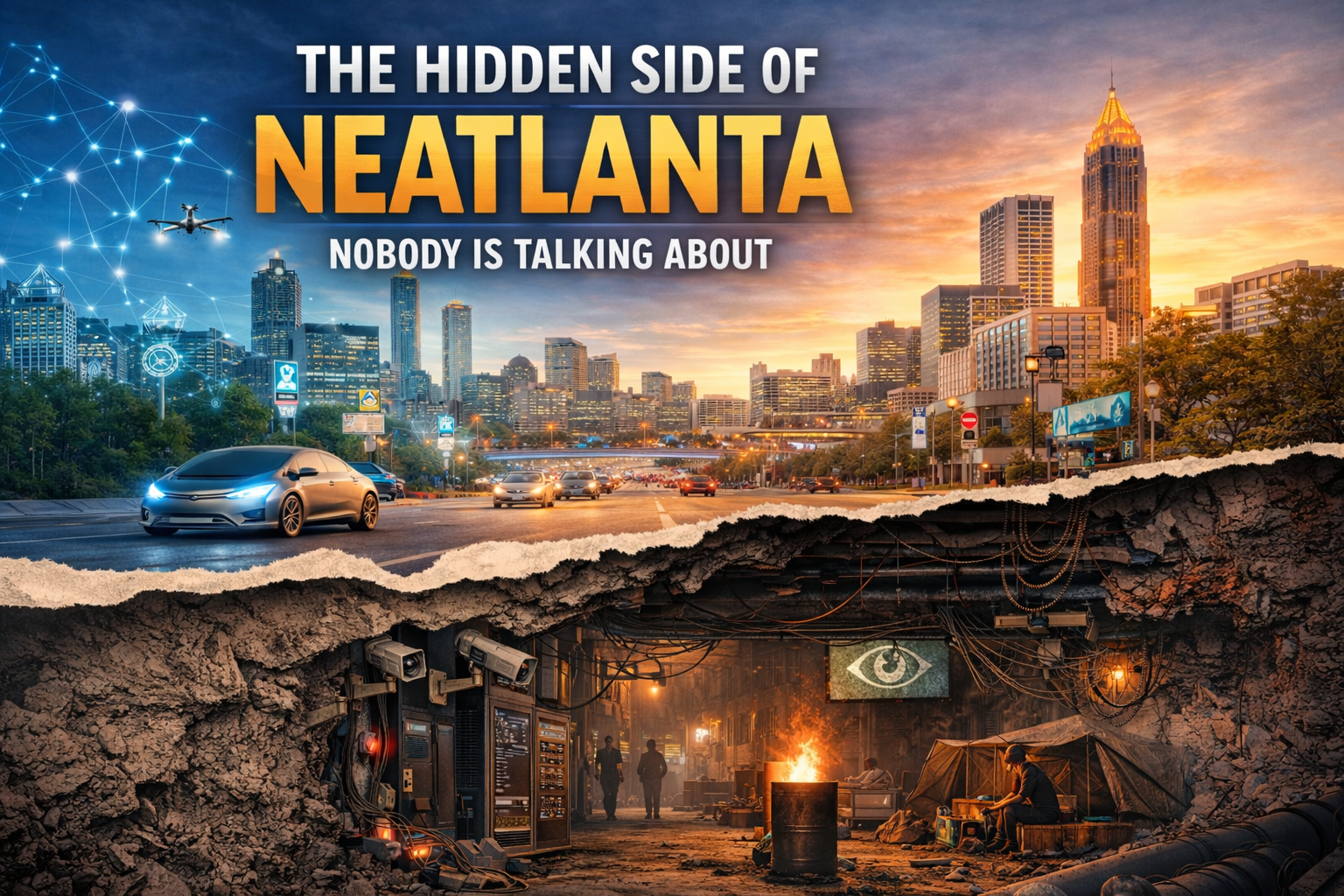
Introduction The Story Everyone Is Telling… and the Part They’re Not.
This is the story that you have likely seen being repeated time and again in anything that you have read about Neatlanta in the recent times.
A smarter city.
Better infrastructure.
Seamless technology.
A dystopian Atlanta in the future where everything is working.
And just to be equal, that version is not the wrong one.
But it’s incomplete.
Since behind each brilliant idea of the smart city, there is an underbelly-one that is often not present in the slickly-written blog posts or advertising campaigns. It is not that glitzy, not as readily definable and certainly not as popularly discussed.
This article is concerning that layer.
Not the headlines. Not the marketing.
The darker side of Neatlanta–the side that makes it or makes it fail.
Neatlanta is Not So Much a Tech Project–It is a Social Experiment.
It is believed that the majority of people consider Neatlanta as being technology.
Connections, information, automation, sensors.
However, a closer look will reveal that it is actually about something different:
Modifying the lifestyle of people, their mobility and interaction with their surroundings.
Installation of smart traffic lights or faster internet is far easier than that.
Technology is predictable, therefore.
Human behavior isn’t.
The city can be constructed ideally on paper and then as soon as the real people engage with the city they come with their habits, resistance and expectations and things become complicated.
There is where Neatlanta is not so much of a tech project… and so much a live experiment in human behavior.
The Data Question Nobody Wants to Ask.
Now I want to discuss something that most articles do not want to discuss.
Smart cities run on data. Massive amounts of it.
All of the movements, all the traffic schemes, all the interactions with the public services–they all become pumped into the systems, which are aimed at making the city smarter.
Sounds efficient, right?
It is. But here’s the hidden side:
Who owns that data? And how is it being used?
In such a location as Atlanta where Neatlanta is defining the future infrastructure, data is becoming one of the most important things within the city.
And there with come real causes:
- Privacy
- Surveillance
- Data security
- Potential misuse
The reality is that the majority of the population likes convenience- but does not really comprehend the trade-offs that are used to obtain it.
It is not only about smarter systems at Neatlanta.
It is concerning the percentage of our life that we will expose to the trade of such convenience.
Convenience vs Control: The Quiet Trade-Off.
This is something which is seldom talked about openly:
The wiser a city is the more organized it is.
It is smart traffic systems that direct the motion.
The utilization of services is optimized using algorithms.
Unpredictability is minimized by automation.
All that enhances efficiency -but can lead to less flexibility.
Chaos is infuriating in a conventional city, but it is also human.
There is nothing wasted in a smart city–however, there is also less chance of spontaneity.
So the real question isn’t:
“Is Neatlanta efficient?”
It’s:
How far can we part with our control in achieving such efficiency?
That is no technical question.
It’s a philosophical one.
The Digital Divide: Who Is an Early Winner?
The visions of smart cities usually have benefits to all.
However, the truth has a different way.
The early benefits are typically enjoyed by in most large-scale projects:
- Tech-enabled communities
- Businesses with resources
- Already existing well-developed areas.
At the same time, underserved groups can take time to experience actual changes.
This is an important point in the case of Neatlanta:
Will the change be spread in an equal manner- or will it be unequally spread?
Otherwise, the development of smart cities may result in unintentional but increased gaps rather than bridging them.
And that can not be cured on its own by all the technology.
Fast Forward Innovation, Sluggish Infrastructure.
Another mismatch that is usually ignored is there.
Technology evolves quickly.
Cities… don’t.
Infrastructure construction is time consuming, co-ordinated and huge. The modernization of a whole city is not as rapid and simple as updating an application, it is complicated and can be very hard to predict.
This creates tension:
- Technology firms are advocating fast innovation.
- Municipal systems need to be stable and long-term.
Neatlanta is in the very center of such tension.
- Moving too fast creates risk
- Growing at a slow pace constrains development.
Balancing between the two is among the largest undisclosed problems.
The Human Factor: Adoption Does Not Come Easy.
Despite the best design systems, failure occurs when individuals do not utilize it.
And here is where lots of smart city concepts fail.
Think about it:
- All people do not believe in new technology.
- People do not always desire to change habits.
- It is not equally beneficial to all.
Other individuals are open to innovation. Others resist it.
The success of Neatlanta does not necessarily rely on technology per se, but rather on the people themselves who need to embrace and believe in that technology.
And trust does not happen in one day.
When Everything Works… Until It Doesn’t
Smart systems are strong- but also come with new vulnerabilities.
In a conventional city, when things go wrong the effect is normally local.
However, in a very networked place as Neatlanta?
One failure would impact more than one system.
For example:
- Traffic systems would be disrupted by a network problem.
- Misrepresentation of data may affect the community services.
- A cyberattack will lead to disruption in a large scale.
It does not imply that smart cities are not safe.
But it does mean:
The concept of resilience is as significant as the concept of innovation.
And strength is an aspect much undiscussed.
The Big Tech Role (And Why It Matters).
There are significant technology players behind any smart city project.
They provide:
- Infrastructure
- Platforms
- Data systems
But they do have a certain influence.
And that is another question underneath:
Who is defining the city, the government sector or technology corporations?
It’s not always a clear line.
The higher the reliance of a city on external platforms, the more its future is pegged on them.
That need not be such a bad thing–but it does imply that decisions are no longer local.
Oversimplification of Neatlanta?
The vast majority of the content concerning Neatlanta makes it look like a linear upgrade:
Better life Smart city Old city.
However, nothing is ever so easily changed in reality.
There are trade-offs.
The indirect effects are unwanted.
Some things are not going to work.
And that’s normal.
The issue is not complexity it is trying to deny that there is.
What Success in Reality Really Means (Beyond the Hype).
What then would a successful Neatlanta actually be like?
Not only in theory–but also in reality.
It wouldn’t be perfect.
It would not remove all the issues.
Instead, it would:
- Make life better without dominating individuals.
- Human needs Balance technology.
- Privacy protection and encourage innovation.
- And cover all communities–not a few.
- Be flexible with time and not without.
Concisely, success is not about being the smartest city.
It is about being the most habitable one.
Why This Hidden Side Matters
You might be wondering:
Why draw attention to the negatives or the challenges?
Since there is no making them vanish through ignoring.
In fact, the opposite is true.
Those cities which are successful are the ones which recognize complexity at the beginning- not those which evade it.
Neatlanta possesses enormous potential.
However, potential is not sufficient.
The outcome is determined by execution, awareness and balance.
Concluding Remarks: Future Atlanta in Reality.
Neatlanta is not only a future dream but also the experiment of how we wish to exist in the future.
Are we more efficient than we are privately?
Convenience over control?
Innovation instead of inclusivity?
There are no easy answers.
But one thing is clear:
The discussion of Neatlanta should look further.
Beyond the headlines.
Beyond the marketing.
The superficial optimism goes deeper.
Since it is not only about what Neatlanta promises.
It is about the way it works in the real world– with real people, real challenges and real consequences.
And that is what no one is making the talk of.