


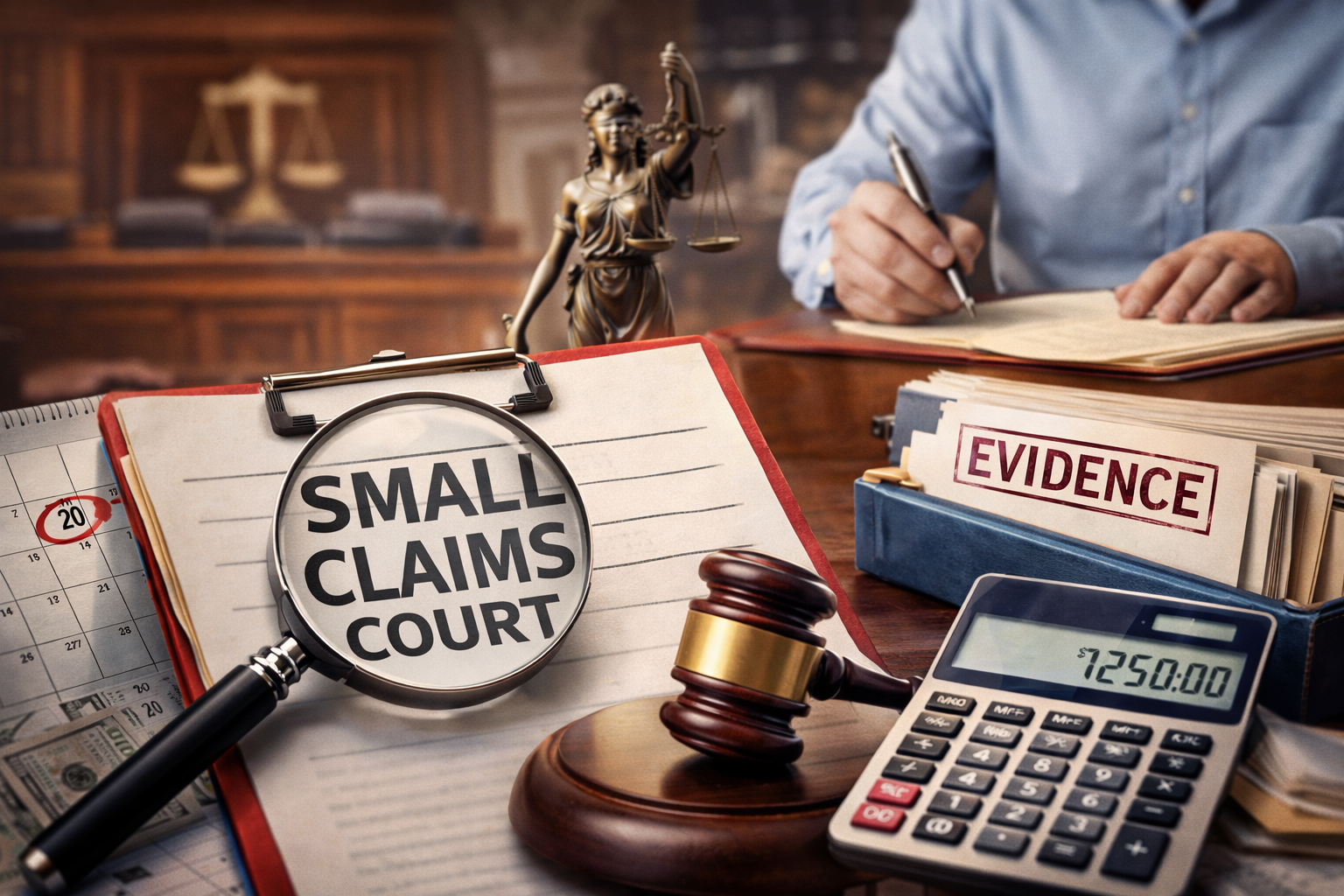
A visit to a small claims court can be very stressful and the first time you visit it. Nevertheless, it is possible to approach your case with confidence and have more chances to succeed provided that you prepare yourself properly. Small claims courts serve to provide the means of efficient and fast resolution of disputes without the necessity of a lawyer.
We will introduce you to all that you should know about small claims court preparation in this guide by explaining how to understand your case and get ready to present it to the court including gathering evidence, filling forms and preparing yourself professionally.
What Is Small Claims Court?
The small claims court is a court specially designed to handle cases that involve rather minor amounts of money. Depending on the state or country, the maximum limit is normally between 5, 000 and 15, 000.
The usual Small Claims Cases are:
● Unpaid bills or loans
● Breach of contract disputes
● Property damage claims
● Security deposit disputes
● Personal lending among the family or friends.
Small claims court is supposed to be easier and quicker than the ordinary civil court and one is supposed to represent himself. This is why you absolutely have to prepare, since the judge will use your evidence and arguments.
First Step: Know Your Case and Your Rights.
You must be well informed about your case before submitting a claim or going to court:
● Type of claim: Be clear on what you are requesting, the sum of money or the definite solution.
● Legal rights: Review local legislation and small claims court regulations. In many instances, government sites give elaborate guidelines.
● Statutes of limitation: There should be deadlines within which many cases that have to be filed. Failure to do so might mean you do not have time to file at all.
Being aware of your rights and duties can assist you to not to make any mistakes that may sabotage your case.
Step 2: Gather Evidence
The small claims case is built on evidence. It is hard to persuade the judge without any clear evidence.
Types of Evidence to Collect:
● Contracts or agreements: Any written agreement or document to the dispute.
● Receipts or invoices: Evidence of payments or debts.
● Emails, messages or letters: Records of communication with the other party.
● Videos or pictures: Evidence that can be seen, particularly when it is about claim of property damage.
● Witness statements: The witnesses who can give an account of what has happened.
Organize Your Evidence:
● Keep folders or binders which are well labeled.
● Provide chronological presentation of documents.
● Prepare copies to yourself, the judge and the other party.
A properly prepared evidence package demonstrates to the judge that you are a serious and ready person.
Step 3: Finish the paperwork that was required.
The kind of forms that are submitted in filing small claims court are specific. Common documents include:
● Claim Form / Complaint: states your case and the amount that you are seeking.
● Summons Form: This informs the defendant that he or she needs to be present in the court.
Ensure forms are correct, submitted and on schedule. In certain courts, it is possible to file online, and it can save time.
Step 4: Computation of Costs and damages.
Be aware of how much you are asking. Include:
● Principal amount owed
● Interest or interest or the charges imposed in case of late payment, provided by law.
● Court charges, which could be recovered.
Take an explicit and written calculation to court. Judges like honesty and candor.
Step 5: You Are Ready to Make Your Courtroom Presentation.
Although a small claims court is informal, presentation does count.
Recommendations to a good Presentation:
● Dress Code: Business casual is normally adequate.
● Be succinct Keep it to the point.
● Make effective use of evidence: Organize documents and photographs.
● Practice what you have to say: Practice what you are going to say.
● Keep a calm and polite manner: Do not quarrel or lose your temper.
Judges prefer well-organized, respectful and factual plaintiffs.
Step 6: Pre-empt the Arguments of the Other Party.
Consider the response that the defendant may give:
● What could be the objections they might have?
● Do you have any gaps in evidence that can be used against you?
● What do you do to refute their claims?
This is because when you are ready to argue the other way around, you are able to defend your arguments and to be more credible.
Step 7: Learn the Procedures in the Court.
The process of small claims courts is generally quite simple:
1. Case called by the judge
2. In first instance, plaintiff submits the case with evidence.
3. Defendant puts their defense case forward.
4. Judge may ask questions
5. Judge renders a decision, which is made either instantly or subsequently in writing.
Knowledge of these steps will ease your anxiety level and will enable you to concentrate on making your case clear.
Action 8: Before Court: Keep in View Settlement.
A great number of disputes are solved prior to the trial:
● Speak to the other party and suggest a harmonious settlement.
● Write a settlement agreement in case the settlement is achieved.
● Inform the court whether the case is solved.
Out-of-court settlement saves time, money and stress.
Step 9: Pre-planning of Post-Judgment Steps.
Winning a small claims court does not mean that one gets money instantly. After judgment:
● Payment scheme: Agree on the payment plan with the defendant to pay in instalments.
● Enforcement: Other courts will help to garnish wages, bank a lien or bank levy.
● Appeals: In the event that you lose, look to see whether an appeal, or other resolution, can be made.
Being aware of what to do once the decision is made is a guarantee that one can exercise his or her rights in an effective manner.
Extra Tips for Success
1. Be organized – Duplicating evidence is beneficial to your credibility.
2. Get down to facts – Judges want to see the facts and not the feelings.
3. Be professional – do not blame or argue.
4. Cite statutes – Use statutes when appropriate.
5. Rehearse your speech – Confidence is important.
Final Thoughts
Small claims court is not something to be afraid about preparing. Learning your case, finding a good evidence, and structuring your presentation, you will have better chances of achieving a desirable result. Small claims court should be available and easily accessible but in order to avoid failure, preparation is the key to success.
Regardless of whether you intend to file a claim or defend yourself, these steps would guarantee you can be able to tackle your small claims court case with a calm, confident and effective manner.