


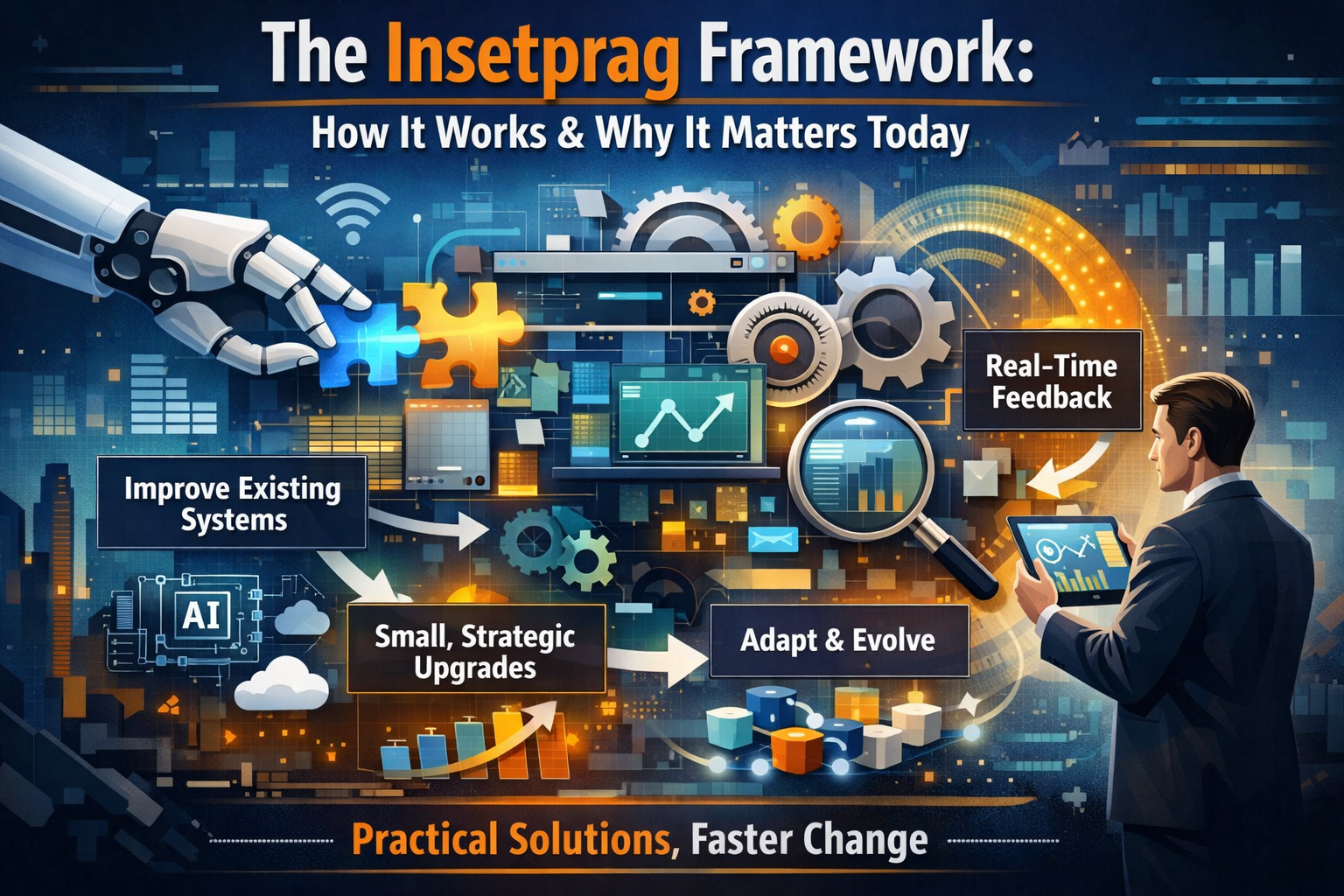
In the current dynamic digital world, organizations, technologies, and businesses are under the constant pressure to change within a short time. Conventional systems are usually a problem, as they are introduced to cemented structures, lethargy in decision-making, and massive changes, which consume resources and time. It is at this point that the Insetprag framework fits in.
Insetprag is a new phenomenon that is aimed at implementing the practical solutions directly to the existing systems and not destroying everything and starting it afresh. It is a combination of inset (inclusion) and prag (pragmatism or practical action) to form a flexible and adaptive model of innovation.
The Insetprag framework can promote small and strategic changes that can be used to complement existing systems instead of making significant changes, thereby simplifying change, becoming more inexpensive, and quicker to implement.
This paper discusses the functionality of the Insetprag framework, its main concepts, advantages, and the reasons why it has gained more relevance in the contemporary industries.
What Is the Insetprag Framework?
The Insetprag design and innovation framework is a design and innovation strategy that places practical rationale, context awareness, and flexibility in systems. It allows systems to learn through feedback and adapt on a real-time basis as opposed to using rules.
Simply put, Insetprag is concerned with:
● Upgrading rather than changing existing systems.
● Doing little but significant changes.
● Giving decisions based on real-life feedback.
● Developing solutions which are context sensitive and adaptive.
For example:
● Use of AI to add functionality of legacy software rather than re-writing it.
● Digitizing the traditional classrooms.
● Enhancing the supply chains with up-to-date information instead of reengineering the whole process.
These tiny changes persist and bring about effective change.
The Fundamentals of the Insetprag Framework.
There are a number of key principles to the success of the Insetprag framework. The ideas form the foundation on which the framework is implemented in real life.
1. Embedded Pragmatism
Insetprag is based on practical problem-solving. The framework is underlined with solutions that are practical in real-life situations rather than stressing on theories or long-term strategies.
The goal is simple:
Practical improvement of real problems.
This would make sure that innovations are not simply creative, but implementable, too.
2. Context Awareness
Insetprag systems are designed in such a way that they can be able to comprehend the surrounding environment that they are operated in. They use the information provided by users, information sources, and states of operations in order to make superior decisions.
This situational awareness has the ability of systems to:
● Revise plans in accordance with reality.
● React to unpredictable modifications.
● Enhance the accuracy of decision-making.
As an illustration, a smart traffic system may arbitrarily change the signal timing, according to congestion, weather and accidents, instead of using a predetermined schedule.
3. Minimal, Tactical Enhancements.
Insetprag is based on small, targeted innovations compared to traditional models of innovation which are based on massive upgrades.
Such an approach has a number of benefits:
● Lower risk
● Faster implementation
● Easier testing
● Continuous learning
Through the years these minute changes add up to major advancement.
4. Feedback and Adaptation in Continuous Fashion.
Insetprag lays stress on feedback loops. All the measures made in the system are checked, and the outcome is used to enhance the decision in future.
It is implemented in the following four phases:
1. Implement a change
2. Measure results
3. Analyze feedback
4. Improve the system
Through this cycle, systems become efficient and intelligent with time.
5. Modular and Scalable Design
Insetprag advocates modular architecture, that is, systems are constructed out of independent components, which can be maintained separately.
This strategy will enable systems to:
● Grow without full redesign
● Absorbing new technologies with ease.
● Stable but develop changes.
With the advancement in technology, new modules can easily be incorporated without having to disturb the whole system.
The Process of the Insetprag Framework.
To get a feeling of the practical aspect of the framework, we are going to examine the working process in a step by step manner.
Step 1: Identify Real Problems
The initial thing is to determine the most urgent problems in a system. Insetprag does not aim to solve all the problems simultaneously, but rather solves the most significant ones first.
Step 2: Add Pragmatic Solutions.
When the problem is detected, specific solutions are directly implemented into the system. These are little but effective solutions.
Examples include:
● Automation tools
● AI-powered analytics
● Workflow improvements
● Data-driven decision models
Step 3: Results Monitoring and Analysis.
On completion of the improvements, the system gathers data to measure performance.
Metrics may include:
● Efficiency
● Cost reduction
● User satisfaction
● Operational speed
Step 4: Refine and Expand
In the case that the solution becomes successful it can be further extended or enhanced. Otherwise, it can be modified or substituted with very little inconvenience.
This adaptable methodology makes sure of the continuous improvement.
Insetprag in World Applications.
Insetprag framework may be implemented in various industries.
1. Artificial Intelligence and Technology.
The current AI is based on the importance of contextual knowledge and flexibility.
Insetprag also helps achieve these features by incorporating adaptive decision-making and real-time data analysis.
Examples include:
● Smart assistants
● Computerized customer services.
● Self-learning computer applications.
2. Business Strategy
Insetprag enables companies to enhance operations without restructuring at an expensive cost.
For instance:
● The integration of the use of digital tools into current working processes.
● Streamlining the supply chains using predictive analytics.
● Enhancing customer experiences on data insights.
This is one of the ways that businesses can remain competitive without radical changes.
3. Smart Infrastructure and Cities.
Insetprag finds much application in city development.
Examples include:
● Smart traffic management
● Energy-efficient buildings
● Dynamic transport infrastructure.
The solutions enhance efficiency of cities, and they also conserve the current infrastructure.
4. Education
Insetprag can be implemented in educational institutions by slowly introducing technology into the conventional learning processes.
Examples:
● Online learning platforms
● Digital interactive materials.
● Tutoring systems based on AI.
These are additions to current teaching systems that increase the learning outcomes.
The advantages of the Insetprag Framework.
With this approach, Insetprag brings about a number of benefits to the organization.
Faster Innovation
Incremental innovations can be fast tracked and made in a short time.
Lower Costs
Insetprag saves costs since it does not introduce new systems to replace the existing ones.
Greater Flexibility
Adaptive systems are sensitive to change.
Better Decision-Making
The analysis of data based on the context will facilitate smarter and more accurate decisions.
Reduced Risk
Incremental changes minimise the risk of huge changes.
The Insetprag Framework is important nowadays.
Modern world is characterized by the complexity, high rate of technological evolution and the presence of uncertainty. Conventional planning models fail most of the times due to the assumptions that things are constant.
Insetprag is able to overcome this difficulty by creating systems that have the ability to continuously change rather than sticking to a rigid plan.
This renders it particularly useful in such fields as:
● Artificial intelligence
● digital transformation
● global business strategy
● smart infrastructure
Essentially, Insetprag changes the emphasis on the future to the creation of systems that have the ability to evolve along with the same.
The problems of applying the Insetprag Framework.
The framework is not without its challenges even though it has benefits.
Difficulty of Implementation.
The adaptive systems need to be designed and integrated.
Ethical Considerations
What is being continually automated and decided on should be open and responsible.
Cultural Resistance
Companies can be unwilling to follow new adaptive strategies.
To handle these challenges, it needs a good leadership, strategies and constant learning.
The Future of Insetprag
With the constant development of such technologies as AI, IoT, and data analytics, the significance of adaptive frameworks like Insetprag is bound to increase.
Possible future developments will involve:
● AI-driven adaptive systems
● independent decision-making platforms.
● business operations that are self-optimizing.
● smart urban infrastructure.
These developments will render Insetprag a necessary practice among the organizations that want to be viable in both the long-term and innovative.
Conclusion
Insetprag framework is an influential change in systems designing and enhancement. It does not depend on the dramatic changes but aims at incorporating the practical changes into current systems.
Insetprag helps organizations to be fast in adapting to an unpredictable world by integrating context awareness, incremental innovation and continuous feedback.
With change occurring quicker than it has ever happened, models such as Insetprag have offered a viable way ahead – a way to make the businesses, technology, and communities in the world smarter, more robust and more efficient.