


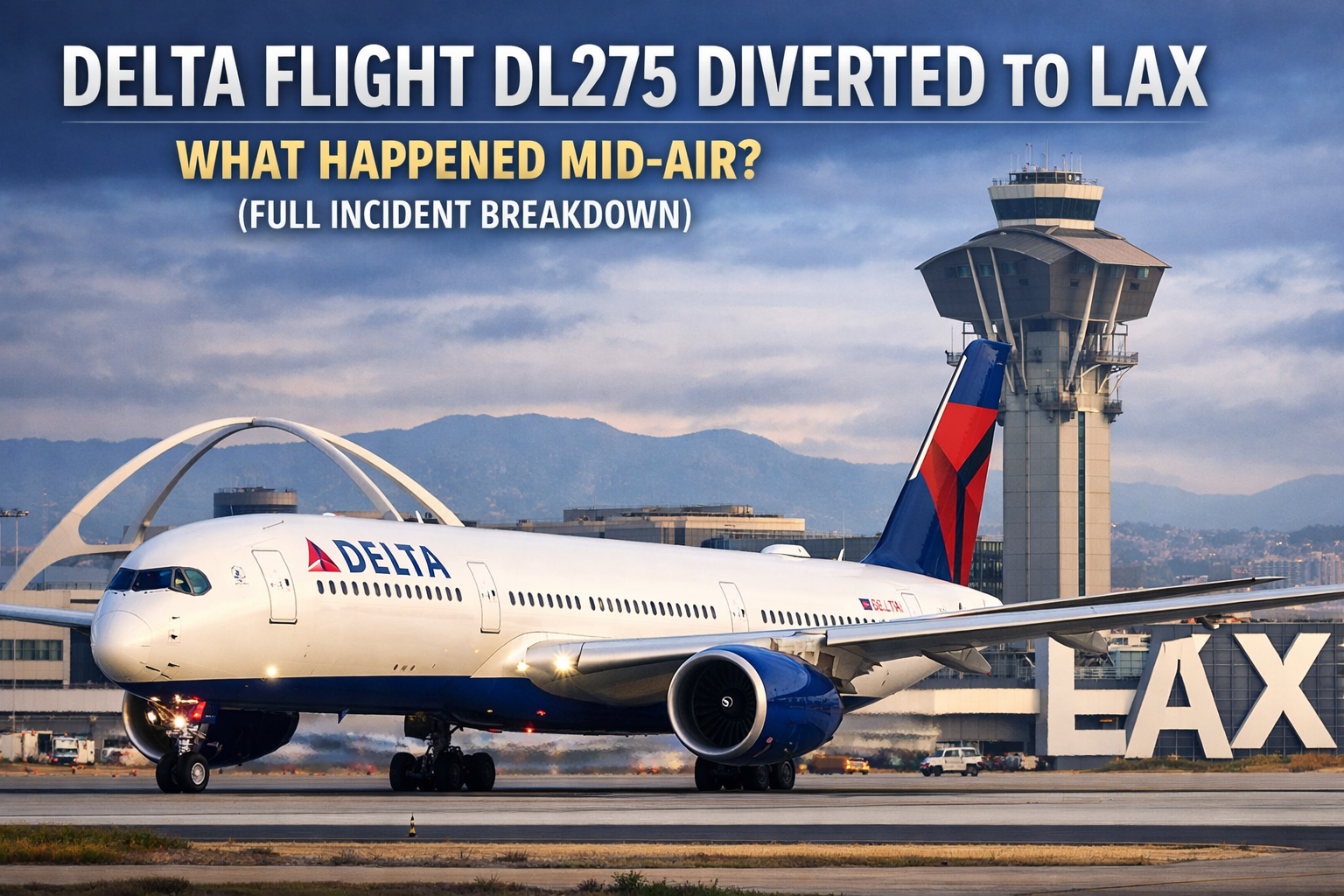
Air transport is among the safest means of transport in the world, however, in some situations there might be need to divert the flights on technical or safety grounds. The Delta Flight DL275 has been in the news recently because it made an unintended landing at
Los Angeles International Airport in the middle of a long-haul flight.
The Delta Air flights had been flying between Detroit Metropolitan Wayne County Airport in the United States to Tokyo Haneda Airport in Japan when the crew members made the decision of diverting the plane to Los Angeles International Airport (LAX).
So what then was it that happened mid-air? What was the motivation behind the decision to change the course of the flight by the pilots and what does it imply to passengers and aviation safety? In this total collapse, we will discuss the event, the potential cause of the event, the safety measures that were taken and what the passengers went through in the diversion.
Overview of Delta Flight DL275
We can first get acquainted with the fundamentals of the flight before getting into the specifics of the diversion.
● Flight Number: DL275
● Airline: Delta Air Lines
● Route: Detroit → Tokyo (Haneda)
● Aircraft: Airbus A350-900
● Scheduled Time in the air: 13 hours.
● Airport D3: Los Angeles International Airport.
Detroit to Tokyo route is a trans-pacific one, that is, the aircraft wastes a considerable time airborne over the sea. Due to the isolated nature of the route throughout the flight, pilots need to be very keen on observing the aircraft infrastructure and make a safe judgement in case any technical problem is detected.
At which point the Problem was Identified.
It is reported that the flight was flying normally at a high altitude when the cockpit crew realized that there would be a possible technical problem with the aircraft engine system.
During cruising altitude, which is usually between 35,000 and 40,000 feet, aircraft systems should be operating flawlessly since the atmosphere is very cold and of very low pressure. Even the slightest technical alerts may need urgent consideration.
The pilots observed conventional aviation procedures:
1. Research into the warning message.
2. Refer to instructions of operation.
3. Liaise with airline operations.
4. Assess safety risks
The problem was not yet pressing, but the crew members found that they were not the safest in keeping the long oceanic path back to Japan.
The Reason Why the Flight was diverted to LAX.
In case a long-distance flight is faced with a technical problem, pilots are forced to make a decision that will:
● Continue to the destination
● Return to the departure airport.
● Divert to the closest appropriate airport.
The diversion point in this case was chosen to be the Los Angeles International Airport (LAX).
Reasons LAX Was Chosen
LAX is an ideal diversion airport due to a number of reasons:
1. Large Foreign Airport.
The LAX is a very large airport in the United States capable of supporting such a large aircraft as Airbus A350.
2. Maintenance Facilities
They have maintenance crews and technical support staff of large airlines like Delta Air Lines.
3. Long Runways
The width of the body airplanes needs to be runway length and the runways available at the LAX are ample enough to make a safe landing.
4. Passenger Support
Airlines are able to rebook customers easier and book accommodation at one of the key hubs.
Due to these reasons, the best and most secure alternative was to switch to LAX.
What Has Occurred in the Diversion.
The flight crew commenced with the process of the diversion after that decision was made.
Step 1: Notification of Air Traffic Control.
Air traffic controllers were contacted and pilots requested them to move them on a new route to Los Angeles.
Step 2: Updating the Cabin Crew
The situation was brought to the attention of flight attendants so that they could prepare passengers on the change of plan.
Step 3: Passenger Announcement.
Passengers had been informed that the flight was diverting to have technical check that was precautionary.
Step 4: Adjusting Flight Path
Slowly the plane was diverted towards California rather than proceeding across the Pacific Ocean.
Step 5: Safe Landing
Several hours later, the plane safely landed in Los Angeles International Airport.
Luckily, no one was injured and the landing was usual.
Passenger Experience in the Incidence.
It may be disorienting or unpleasant to many of the passengers who may have just been got off track by an abrupt change of flight. Nonetheless, contemporary air traffic standards are meant to ensure that passengers are updated and on board with ease.
Communication From Crew
The passengers are usually informed by:
● The pilot
● The cabin crew
● Airline messages or applications.
Effective communication will avoid panic and assure the travelers that the situation has been contained.
Arrival at LAX
Upon landing, the following was aided to passengers:
● Reduction in alternate flight rebooking.
● Hotel rooms (in case of necessity)
● Customer service support
Delay is usually related to long-haul diversions at the expense of which airlines are trying to decrease the disruption as much as possible.
Was This an Emergency?
The major question that many people pose whenever they are informed that a flight has been diverted is whether it was an emergency.
In the majority of situations, such as this, the cases of diversion are not emergency cases, but precautionary situations.
The pilots are taught to put safety on first. When there is a system alert they will tend to deviate even when the plane may still be technically airborne.
This is the reason why, this conservative method has made commercial aviation so safe.
What is the prevalence of Flight Diversions?
Although they might sound dramatic, flight diversion although not very frequent is common in the international aviation.
Typical reasons include:
● Mechanical issues
● Medical emergencies
● Severe weather
● Security concerns
● Airport congestion
The majority of the diversions come to a dead stop in this manner safe landing with no injuries.
Safety of the Airbus A350
The aircraft in which the flight was operated, Airbus A350-900, is among the best passenger aircraft in the world.
Key Safety Features
● Hi-tech surveillance systems.
● Fuel-efficient engines
● Redundant safety systems
● Long-range capability
The airplane constantly monitors the systems on the plane and notifies the pilots in case of anything anomalous.
Such safety systems are in-built and assist the crews to make prompt decisions.
Post-Diversion What happens after a Diversion?
After a diverted plane has landed, a number of procedures occur before the plane flies.
1. Technical Inspection
The aircraft is checked by the maintenance engineers to determine the problem.
2. Repairs or System Reset
In case an issue is detected, it is solved or replaced.
3. Safety Approval
The plane has to undergo airworthiness test prior to re-entry.
4. Passenger Rebooking
They transfer passengers to other flights or accommodate the passengers as necessary.
These precautions are taken very seriously by the airlines so that the aircraft would be safe to operate in future.
The way Airlines manage passenger delays.
Airline companies are expected to assist the passengers in case of diversions.
This may include:
● Meal vouchers
● Hotel stays
● Other flight bookings.
● Customer support service.
Airline policies are different depending on the airline and the situation but most of the major carriers such as Delta Air Lines are always keen on ensuring that any disruptions are minimal.
The Reason Diversions Are not a bad thing.
Although the idea of flight diversion may be frightening, it shows the efficiency of the aviation safety systems.
Pilots have been trained on how to respond to minor issues that end up being major problems.
The major safety principles are:
● Timely identification of technical warnings.
● Right-wing decision-making.
● Access to other airports in time.
● Central contact with airline activities.
These processes make sure that the safety of passengers is the priority always.
Final Thoughts
The oversight in the safety of the aviation industry is a reminder of the precaution the Delta Flight DL275 took when it was diverted to Los Angeles International Airport.
Though the flight was initially planned as a flight ready to fly between Detroit Metropolitan Wayne County Airport and Tokio Haneda Airport, the crew took the responsible choice of rerouting the flight after realizing that there was a possible technical issue.
Due to stringent safety measures, senior pilots as well as sophisticated technology on the planes, the plane landed safely and people managed to resume their trips.
Finally, the incident may also be seen as a sign that the current aviation is built in such a way that even unforeseen circumstances can be addressed safely and in a professional manner.