


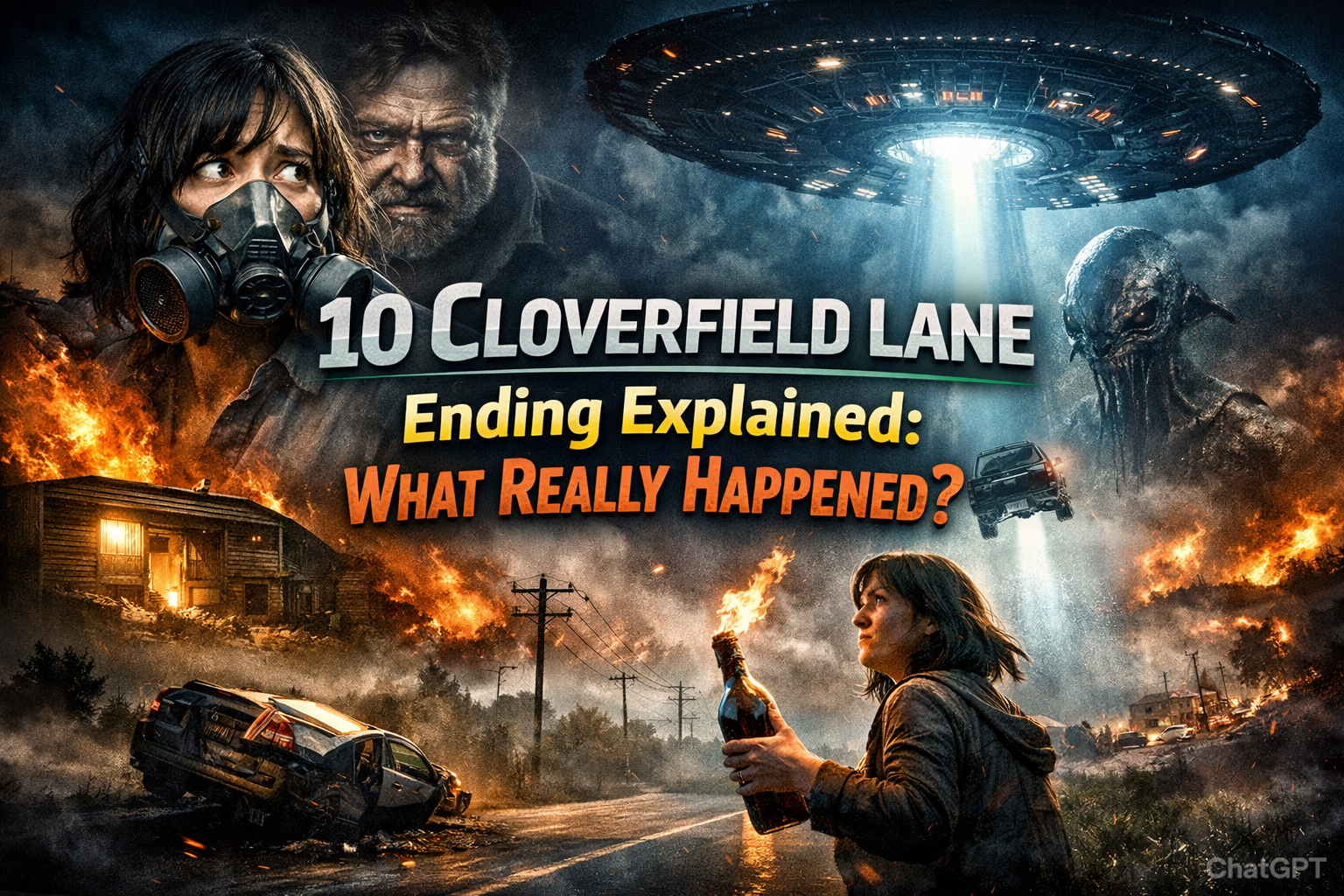
There is not many contemporary thriller that has attracted so much controversy as 10 Cloverfield Lane. The movie starts as a tensed psychological thriller within a bunker. Towards the end it becomes a full scale sci-fi survival movie.
In case you are in need of a definitive and detailed dissection, this guide reveals how 10 Cloverfield Lane ends, its secret message, the alien twist, and how it fits into the wider Cloverfield universe.
Quick Recap of the Final Act
Let us have a brief recap of what occurs in the final scenes first before we analyse the meaning.
On learning the truth about Howard being violent, Michelle flees out of his underground bunker. She strikes him in self-defense and she goes out. In the beginning, it appears that the air is breathable. To a small extent, it seems that Howard could have been lying about the outside world.
Then everything changes.
Michelle also notices sight of alien spaceships flying in the sky. One of them steals her automobile using a ray of light. She manages to get away safely, burns down the alien ship with a self-built Molotov cocktail.
The last twist ascertains two things:
- Howard was correct concerning a colossal assault.
- However, he was mistaken as to control being the answer.
Was Howard Telling the Truth?
This becomes the major issue in the film.
All through 10 Cloverfield Lane, Howard maintains that there was a chemical or nuclear attack. He claims the air is toxic. According to him, he rescued the life of Michelle. Yet he is not reliable as a result of his unstable behavior.
The Complicated Answer
The conclusion gives an overlaid truth:
- There is an alien invasion.
- The external world is threatening.
- But Howard is still controlling and threatening.
He was correct about a threat. But his paranoia, abuse and violence existed. It is not justifiable to kidnap or take control, just because one is correct in regards to the invasion.
The film is also very intelligent in making viewers doubt trust, fear and survival.
The Alien Twist Explained
The alien uncovering splits viewers. Some love it. Others find it abrupt.
Why the Alien Scene Matters
The alien appearance has three significant functions:
- It Expands the Story
Much of the film has a small and personal conflict. After the appearance of the aliens, the narrative becomes international. It is no longer just a threat to Howard. It’s humanity’s survival.
- It Validates the Suspense
The film creates a sense of tension on uncertainty. At the moment when the alien ships come into the frame, the tension is rewarded. The threat was actual– only not in the precise manner that Howard had indicated.
- It Connects to the Franchise
The invasion of the aliens connects the movie to the greater universe that the Cloverfield Paradox is part of and started with Cloverfield.
Instead of being an immediate follow-up, 10 Cloverfield Lane functions as a compilation to an anthology-like science-fiction world.
The Character Arc of Michelle: The Actual Interpretation of the Ending.
The alien invasion is not the real central of the ending. It’s Michelle’s growth.
At the Beginning
Michelle flees confrontation. An argument with her fiance makes her leave him. She does not solve problems, but evades them.
Inside the Bunker
She feels trapped again. Howard tries to manage her life. The bunker is turned into a haven and a jail.
At the End
When Michelle flees she has a choice.
There are two ways out: a voice on the radio.
- Go toward safety.
- Head to Houston, survivors are retaliating.
She chooses to fight.
This choice is the last step in her transformation. She stops running. She confronts danger head-on.
The death is not only concerned with aliens. It’s about courage.
The Reason the Ending Seems like a Different Movie.
Most audiences affirm that the last 10 minutes of the film are like a different movie. That shift is intentional.
During the majority of its duration, 10 Cloverfield Lane is a psychological thriller. The conflict is caused by mistrust and insecurity. The alien unmasking changes the genre into sci-fi action.
This opposition brings out one strong point:
There is danger that is sometimes concealed by paranoia.
The change is also a reflection of the inner world of Michelle:
- Self conflict- War with others.
- Fear-Physical survival Emotional fear.
The conclusion is an expansion of the story and the character.
Symbolism in the Final Scene
This conclusion has many symbolic elements, which enhance its meaning.
The Bunker
The bunker is the symbol of survival on the basis of fear. Howard is of the view that being isolated and controlled is to be safe. However, such an attitude is poisonous.
The Outside Air
As Michelle goes outside and inhales fresh air, this is a representation of freedom and uncertainty. Protection within the bunker was expensive. Freedom carries risk.
Fire and Improvisation
Michelle manages to kill both Howard and the alien ship with the help of improvised equipment. This is an allusion to human strength. She adapts instead of hiding.
Is 10 Cloverfield Lane a Sequel?
Technically, no. Nevertheless, it is in the same universe.
The original Cloverfield is based on the massive attack by monsters in New York.
10 Cloverfield Lane presents alien vessels and the global invasion. The Cloverfield Paradox later proposes multiverse as an explanation of these events.
The franchise is anthology based. Both movies dwell upon the theme of fear, differently:
Monster chaos
- Psychological control
- Cosmic science fiction
- The relation is thematical not direct.
Was Howard the Real Villain?
Howard is still one of the most complicated characters in the modern sci-fi thrillers.
He:
- Prepared for disaster.
- Built a bunker.
- Rescued Michelle in a road accident.
But he also:
- Kidnapped her.
- Killed Emmett.
- Manipulated people around him.
The resolution demonstrates that a person may be right regarding danger being corrupt in his or her actions.
Howard is an embodiment of fear at its fullest. Living is living without humanity is being a prisoner.
What the Final Scene Really means.
There is much in the last shot of Michelle in her car on her way to Houston.
She does not avoid confrontations anymore. She opts to have a purpose rather than to be afraid. She becomes a survivor to become a fighter.
The invasion of aliens attests that the world has been ruined. There is hope though in the choice that Michelle makes.
The film ends up providing the following message:
- Fear can distort behavior.
- Control is not protection.
- Expansion needs defiance.
- Survival alone is not enough.
Why the Ending Works
The film, despite controversy, ends successfully on a number of reasons:
- It brings a shocking yet reasonable twist.
- It works out the psychological tension.
- It adds another dimension to Cloverfield.
- It brings the character of Michelle to a close.
The alien introduction can be shocking, yet it supports rather than changes the themes of the film.
Final Thoughts
The 10 Cloverfield Lane is an experiment in a narrative, combining a psychological thriller with a sci-fi invasion. The finale proves that there is an external danger. However, the bigger picture is that of individual change.
Howard had been correct on danger. Michelle did not go wrong by running away. And her choice not to run anymore was a true victory.
In case you were looking to find a complete explanation of the 10 Cloverfield Lane ending, then you would find it in the plot and in the character. It is the aliens who enlarge the narrative, but the decision of Michelle characterizes it.
The last bend towards Houston is not merely regarding combat against invaders. It is a matter of making a decision to be bold rather than be scared. And that was what actually was the case.